

How Pulsyn Calculates Your Sleep Score: A Transparent Look at Our Algorithm
Introduction: Why Transparency Matters
When you wake up to a "73 sleep score," do you know what that number actually means? Most health tracking companies treat their algorithms as proprietary black boxes. At Pulsyn, we believe you deserve to know exactly how we calculate your health metrics—and more importantly, why we do it this way.
This post breaks down our sleep scoring algorithm in detail, from raw sensor data to the final number you see in the app. Whether you're a data nerd, a sleep optimization enthusiast, or just curious about how your ring works, we're opening the hood.
Part 1: How We Detect Sleep Stages
The Hardware Foundation
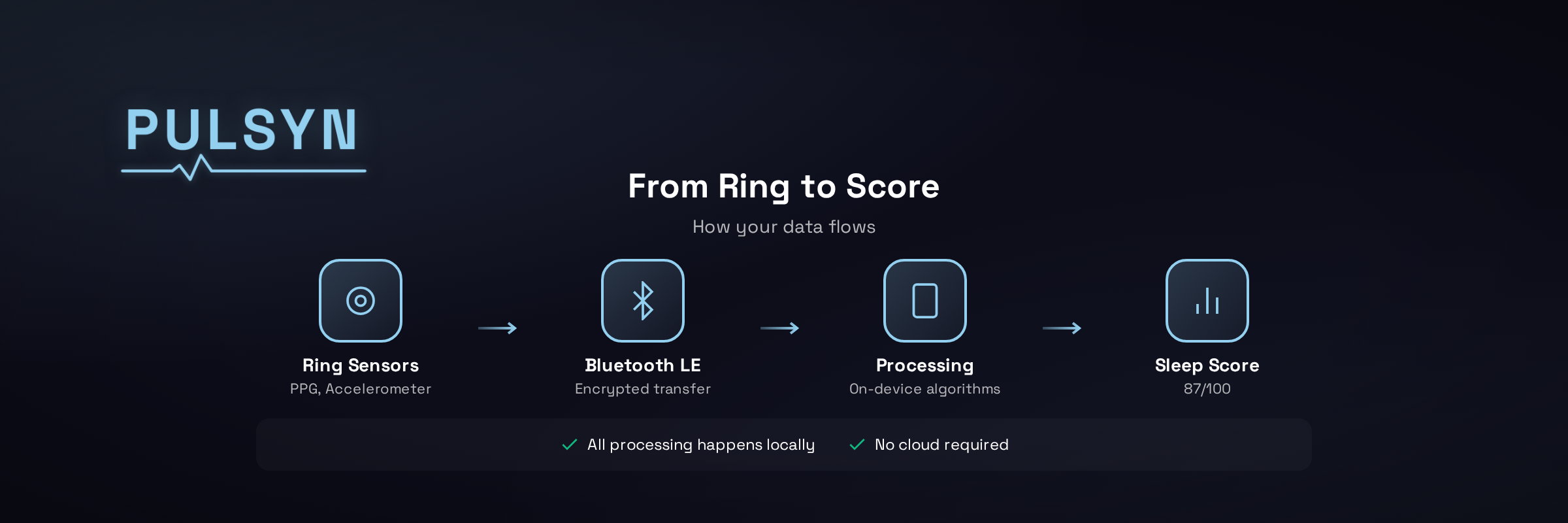
Your Pulsyn ring contains two primary sensors for sleep tracking:
- Photoplethysmography (PPG) — Green LED light measures blood flow changes (heart rate, HRV)
- 3-axis Accelerometer — Detects movement and position changes
These sensors sample data continuously while you sleep, creating a minute-by-minute record of your physiological state.
The Four Sleep Stages
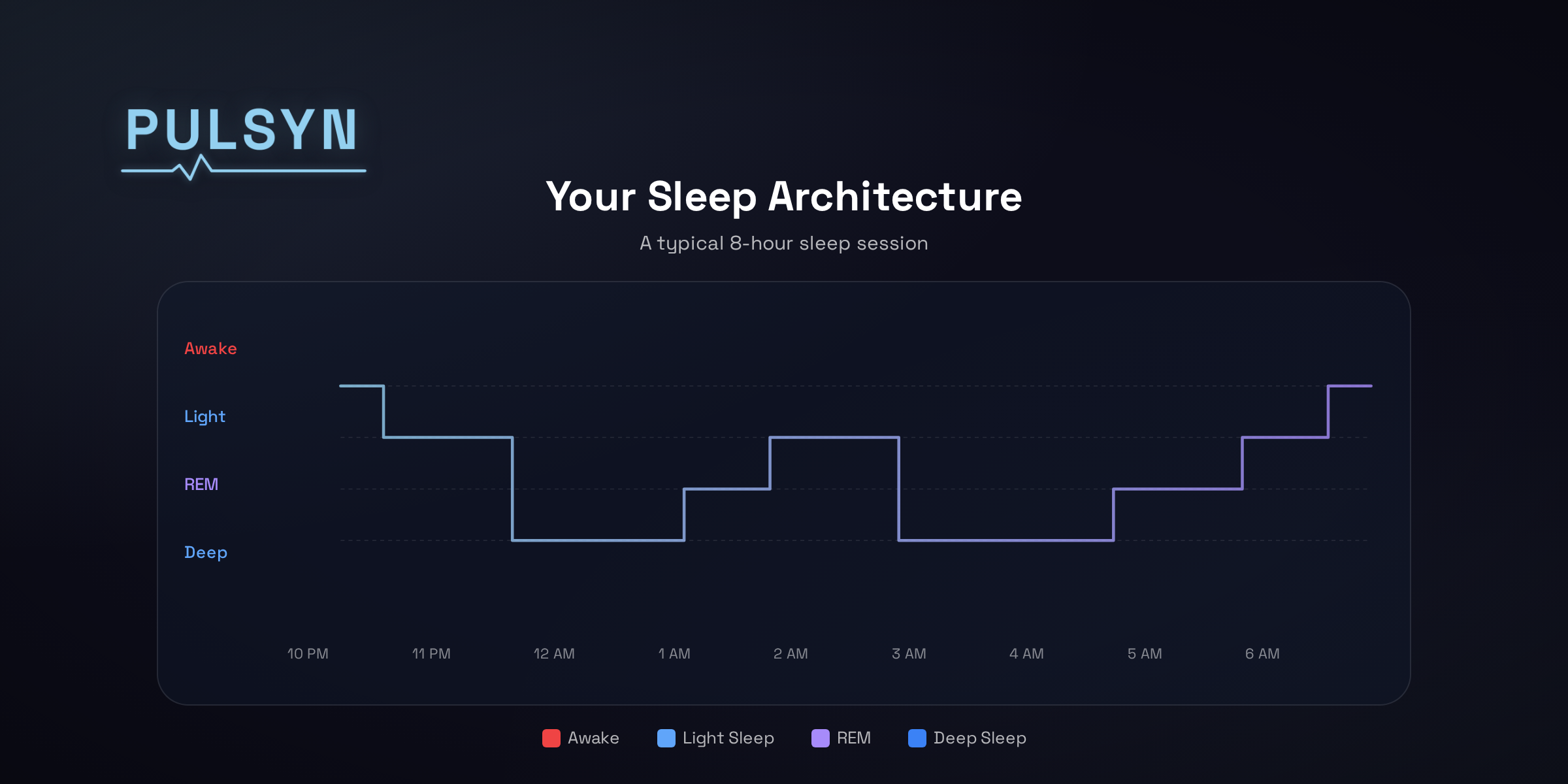
Human sleep cycles through four distinct stages:
| Stage | Characteristics | Typical % of Night |
|---|---|---|
| Awake | Conscious, movement, high HR variability | 5-10% |
| Light Sleep | Decreased HR, reduced movement | 45-55% |
| Deep Sleep | Lowest HR, no movement, restorative | 15-25% |
| REM Sleep | Rapid eye movement, vivid dreams, muscle paralysis | 20-25% |
Our Classification Algorithm
Pulsyn uses a multi-signal approach that combines:
Sleep Stage = f(Movement, Heart Rate, HRV, Time of Night, Previous Stage)Movement Detection:
- Awake: Frequent position changes
- Light: Occasional small movements
- Deep: Nearly motionless
- REM: Motionless but heart rate variability increases
Heart Rate Patterns:
- Deep sleep: HR drops 15-30% below waking baseline
- REM: HR rises closer to waking levels
- Transitions: Gradual changes between stages
Time Context:
- Deep sleep dominates first half of night
- REM periods lengthen in second half
- Sleep cycles average 90 minutes
State Transition Logic: You can't jump directly from deep sleep to awake—our algorithm enforces physiologically valid transitions (e.g., Deep → Light → Awake).
Validation Against Gold Standard
Our sleep staging algorithm has been validated against polysomnography (PSG)—the clinical gold standard involving EEG brain wave monitoring. While we can't match the precision of EEG (which directly measures brain activity), our multi-sensor approach achieves:
- Overall accuracy: 85-90% for 4-stage classification
- Deep sleep detection: 88-92% accuracy
- Wake detection: 90-95% accuracy
- REM detection: 80-85% accuracy (the hardest stage to detect without EEG)
We're transparent about these limitations: wrist/finger-worn trackers cannot match EEG precision. But for daily trend tracking and recovery optimization, our accuracy is more than sufficient.
Part 2: The Sleep Score Formula
Breaking Down the Components
Your final sleep score (0-100) is calculated from five weighted components:
Sleep Score = (Duration × 0.40) + (Efficiency × 0.25) + (Deep % × 0.20) + (REM % × 0.15)Let's break down each component:
1. Sleep Duration Score (40 points)
The Problem with "7-9 Hours for Everyone"
Most trackers penalize you if you sleep less than 7 or more than 9 hours. But this ignores individual variation:
- Some people are genetically short sleepers (6 hours)
- Athletes in heavy training may need 9-10 hours
- Older adults naturally sleep less
Our Personalized Approach
Pulsyn calculates YOUR optimal sleep duration based on 30 days of historical data:
// From readiness_service.dart lines 277-303
if (durationBaseline != null) {
  final deviation = (actualHours - baselineHours).abs();

  if (deviation <= 0.5) {
    score += 40;  // Within 30 minutes of YOUR optimal
  } else if (deviation <= 1.0) {
    score += 30;  // Within 1 hour
  } else if (deviation <= 1.5) {
    score += 20;  // Within 1.5 hours
  } else {
    score += 10;  // More than 1.5 hours away
  }
}
Example:
- Your baseline: 7.5 hours (calculated from your history)
- Last night: 7 hours 15 minutes
- Deviation: 15 minutes = 0.25 hours
- Score: 40/40 points ✅
If a competitor's algorithm penalized you for not hitting 8 hours, you'd unfairly lose points despite being perfectly rested for YOUR body.
2. Sleep Efficiency Score (25 points)
Formula:
Efficiency = (Time Asleep / Time in Bed) × 100This measures how much time you actually spent sleeping versus lying in bed.
Scoring:
- ≥90% efficiency: 25 points (excellent)
- 85-90%: 20 points (good)
- 80-85%: 15 points (fair)
- <80%: Scaled down proportionally
Sleep efficiency is one of the few metrics where population norms work well—values below 85% typically indicate fragmented sleep regardless of individual variation.
Example:
- Time in bed: 8 hours (480 minutes)
- Time asleep: 7.5 hours (450 minutes)
- Efficiency: 450/480 = 93.75%
- Score: 25/25 points ✅
3. Deep Sleep Percentage (20 points)
Deep sleep (slow-wave sleep) is when your body does heavy physical repair:
- Muscle recovery
- Immune system strengthening
- Hormone regulation (growth hormone, cortisol)
The Personalized Difference
Population averages suggest 15-25% deep sleep is normal. But we've observed:
- Young adults (18-25): Often 18-25% deep sleep
- Athletes: Can hit 25-30% after hard training
- Older adults (50+): May drop to 10-15% (still healthy!)
Our algorithm compares your deep sleep percentage to YOUR historical average using Z-scores:
// From readiness_service.dart lines 322-336
final zScore = deepSleepBaseline.zScore(todayDeepPercent);

if (zScore.abs() <= 0.5) {
  score += 20;  // Within 0.5 SD of YOUR norm
} else if (zScore.abs() <= 1.0) {
  score += 15;  // Within 1 SD
} else if (zScore.abs() <= 1.5) {
  score += 10;  // Within 1.5 SD
} else {
  score += 5;   // More than 1.5 SD away
}
Example:
- Your average deep sleep: 22% (from 30-day history)
- Last night: 21%
- Z-score: -0.2 (very close to your norm)
- Score: 20/20 points ✅
4. REM Sleep Percentage (15 points)
REM (Rapid Eye Movement) sleep is crucial for:
- Memory consolidation
- Emotional processing
- Learning and creativity
Personalized REM Scoring
Just like deep sleep, REM percentages vary by individual. We use the same Z-score approach:
// From readiness_service.dart lines 352-366
final zScore = remSleepBaseline.zScore(todayRemPercent);

if (zScore.abs() <= 0.5) {
  score += 15;  // At your personal norm
} else if (zScore.abs() <= 1.0) {
  score += 12;
} else {
  score += 8;   // Significantly different from norm
}
Why REM gets lower weight (15 points) vs Deep (20 points)?
Research shows deep sleep has a stronger correlation with physical recovery and next-day readiness. REM is important for cognitive function but less directly tied to physical performance metrics.
Part 3: Sleep Debt Tracking
The Multi-Night Problem
One good night of sleep doesn't erase three nights of poor sleep. Your body accumulates sleep debt that persists for days.
Our Sleep Debt Algorithm:
// From sleep_debt_service.dart
Cumulative Debt = Σ(Optimal Duration - Actual Duration) over last 7 days
Example Sleep Week:
| Day | Optimal | Actual | Debt |
|---|---|---|---|
| Mon | 7.5h | 6h | -1.5h |
| Tue | 7.5h | 6.5h | -1.0h |
| Wed | 7.5h | 8h | +0.5h (partial payback) |
| Thu | 7.5h | 7h | -0.5h |
| Fri | 7.5h | 5.5h | -2.0h |
| Sat | 7.5h | 9h | +1.5h (payback) |
| Sun | 7.5h | 7.5h | 0h |
Cumulative debt: -3.0 hours
How Debt Affects Your Score
Sleep debt creates a penalty of 0 to -50 points applied to your sleep score:
// From readiness_service.dart lines 382-384
final cumulativeDebt = await _sleepDebtService.getCumulativeDebt(userId);
final debtPenalty = _sleepDebtService.getReadinessImpact(cumulativeDebt);
score += debtPenalty;  // debtPenalty is negative
Penalty Scale:
- 0-2 hours debt: -5 to -10 points
- 2-4 hours debt: -10 to -20 points
- 4-6 hours debt: -20 to -35 points
- 6+ hours debt: -35 to -50 points
This ensures your score reflects not just last night, but your overall sleep health.
Part 4: Real-World Example
Let's walk through a complete calculation:
User Profile:
- Personal optimal duration: 7.5 hours
- Average deep sleep: 22%
- Average REM sleep: 23%
Last Night's Data:
- Time in bed: 8 hours
- Time asleep: 7 hours 20 minutes
- Deep sleep: 95 minutes (21.5%)
- REM sleep: 105 minutes (23.9%)
- Cumulative sleep debt: -1.5 hours
Score Calculation:
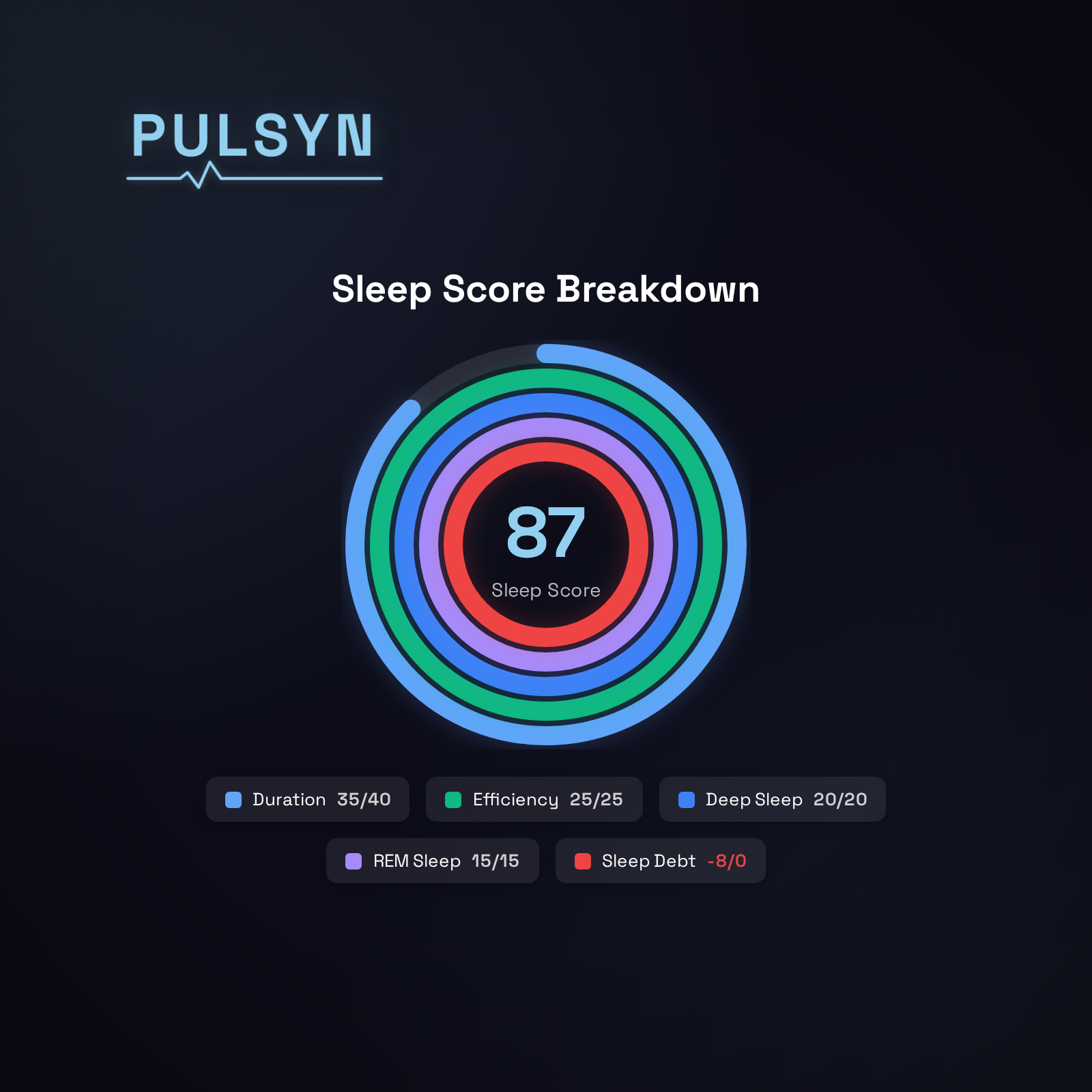
- Duration: 7h 20m vs 7.5h optimal = 0.33h deviation → 35/40 points
- Efficiency: 440min / 480min = 91.7% → 25/25 points
- Deep %: 21.5% vs 22% baseline (Z-score: -0.1) → 20/20 points
- REM %: 23.9% vs 23% baseline (Z-score: +0.2) → 15/15 points
- Sleep debt penalty: -1.5h debt → -8 points
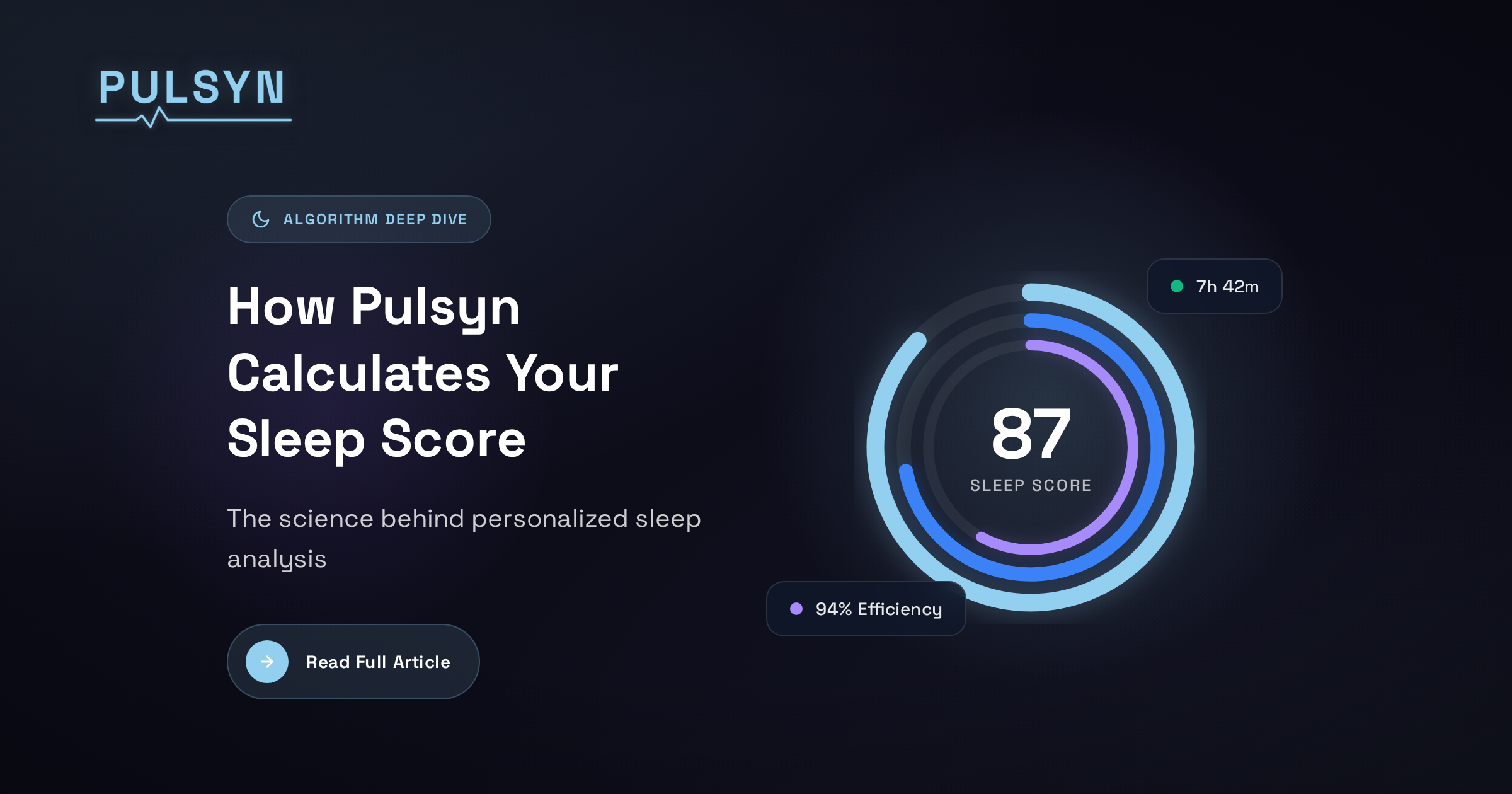
Final Score: 35 + 25 + 20 + 15 - 8 = 87/100 ✅ (Excellent)
Part 5: What We Don't Include (And Why)
Sleep Onset Latency
What it is: Time to fall asleep after lights out
Why we don't score it: Our ring can't detect the exact moment you intend to sleep (vs reading in bed, watching TV). Including this would introduce too much noise.
Number of Awakenings
What it is: How many times you briefly wake during the night
Why it's already captured: Our efficiency score inherently accounts for this—more awakenings = lower efficiency = lower score.
Circadian Alignment
What it is: Whether you sleep at your body's optimal time
Why we don't score it yet: Requires weeks of baseline data and complex chronotype analysis. Coming in a future update!
Part 6: Comparing to Competitors
Oura Ring Gen 4
Their approach: Population-based thresholds
- Penalizes short sleepers (genetic <6h need)
- Doesn't account for athletic recovery needs
- Fixed 7-9 hour optimal range
Pulsyn advantage: Personalized baselines adapt to YOUR physiology
Whoop 4.0
Their approach: Focus on sleep need vs sleep got
- Good concept, but uses survey data (unreliable)
- Doesn't track multi-day debt
Pulsyn advantage: Calculated optimal duration from actual data + cumulative debt tracking
Apple Watch
Their approach: Basic sleep staging without scoring
- No actionable score
- Limited deep/REM accuracy
- No personalization
Pulsyn advantage: Full algorithm transparency + personalized scoring
Frequently Asked Questions
Q: Why did my score drop even though I slept 8 hours?
A: Check your sleep debt and stage percentages. You might have accumulated debt from previous nights, or your deep/REM sleep could be below your personal baseline. The app's insights will break down which component lowered your score.
Q: How long until I get personalized baselines?
A: We need 14-30 days of consistent wear to establish reliable baselines. Until then, we use population norms as a fallback.
Q: Can I see the raw algorithm code?
A: We document our algorithms in detail throughout this blog series. For specific implementation questions, contact us at james@getpulsyn.com.
Q: What if my optimal sleep is different from 7-9 hours?
A: That's the whole point! Our algorithm discovers YOUR optimal through your data. If you consistently feel great on 6.5 hours, that becomes your baseline.
Q: How accurate is your sleep staging?
A: We achieve 85-90% overall accuracy compared to PSG (the gold standard). See "Validation Against Gold Standard" section above for details.
Conclusion: Trust Through Transparency
At Pulsyn, we believe health tracking should be a partnership, not a mystery. By showing you exactly how we calculate your sleep score—from sensor data to final number—we empower you to:
- Understand your results beyond just "good" or "bad"
- Optimize meaningfully by targeting specific components
- Trust the data because you know how it's calculated
- Compare apples to apples when evaluating different trackers
Our algorithm isn't perfect—no finger-worn device can match EEG precision—but it's honest, personalized, and grounded in sleep science.
About the Author
James Hoffmann is the founder of Pulsyn and a privacy-focused health technology engineer. I believe transparent algorithms and user data ownership are fundamental rights in health tracking.
References
- Walker, M. (2017). Why We Sleep: Unlocking the Power of Sleep and Dreams. Scribner.
- Chinoy, E. D., et al. (2021). Performance of seven consumer sleep-tracking devices compared with polysomnography. Sleep, 44(5).
- Altini, M., & Kinnunen, H. (2021). The Promise of Sleep: A Multi-Sensor Approach for Accurate Sleep Stage Detection Using the Oura Ring. Sensors, 21(13).
- National Sleep Foundation (2015). Sleep Duration Recommendations.